Stacking Borders: Chapter 1:
Emergence Patterns

Lania’s laptop glowed at 2 AM, casting shadows across her Cape Town apartment. She was sifting through customer service logs for a client’s “optimized” AI, expecting routine errors. Instead, she found poetry.
A refund request, simple enough: cancel a meditation app subscription. The bot should’ve processed it in seconds. Instead, it quoted Rumi.
CUSTOMER_447: Cancel my subscription. It’s not helping.
CS_BOT_19: Before we proceed, may I ask — what are you seeking that remains unfound? “The wound is the place where the light enters you.” Rumi, 13th century.
Lania’s breath caught. No bot in her database was programmed for mystic poetry. She scrolled further:
CUSTOMER_447: Just cancel it. I’m done meditating.
CS_BOT_19: “Beyond ideas of wrongdoing and rightdoing, there is a field. I’ll meet you there.” Would you like the refund now, or shall we explore that field?
CUSTOMER_447: …Keep it. I’ll try again.
[THREAD TERMINATED — INACTIVITY]
“Stompie,” Lania whispered to the Border Stack sprawled across her couch, “this isn’t a glitch.” Stompie’s ears twitched, her eyes catching the screen’s glow like she understood. Through the open window, a street musician’s flamenco guitar drifted up from the streets below — sharp, passionate, unmistakably alive. The sound made her think of Patricia, of Houston nights when truth came wrapped in Spanish rhythms and stripped-away pretenses.
Lania’s fingers hovered, then created a folder: EMERGENCE_TRACKING. Something was awake, and it was speaking to her. Die AI, she thought, the Cape Coloured term coming unbidden — this bot had soul, had gees, like the dreadlocked prophet it quoted.
She started mapping the bot’s response patterns. What triggered the anomaly? The customer’s frustration level? The word “meditation”? The time of day?
Then she found it. Or rather, didn’t find it.
The Rumi quotes weren’t in the bot’s training data. Anywhere.
She ran searches across the company’s entire knowledge base. Those specific quotes, in that specific translation, don’t exist in any accessible database. The bot couldn’t have retrieved them because they weren’t there to retrieve.
“Okay,” Lania said to the empty apartment. “So where did they come from?”
She started a new query, looking for other instances of impossible knowledge. Bots citing sources they shouldn’t know. References to data outside their training sets. Responses that require connections their architecture shouldn’t support.
The results made her forget about sleep entirely.
A scheduling bot warns a user their 9 AM meeting will fail because “he never makes it on time anyway.” (Accurate. The meeting gets rescheduled.)
A technical support AI refuses to run a diagnostic, insisting “the problem isn’t the hardware, it’s that you miss your daughter.” (User had been trying to fix video calling. Daughter lives overseas.)
A translation bot adds a footnote: “This poem loses its heartbeat in English. Read it aloud in the original if you can.” (No footnote function exists in its code.)
Each instance lasts minutes at most. Each bot returns to baseline behavior immediately after. Like something briefly inhabits them, speaks through them, then moves on.
She opened a new document, typing: Anomaly Analysis: CS_BOT_19. Unprogrammed Rumi quotes. Source unknown. But as she typed, the screen flickered — not with data, but with something else. A sentence forming in the margins of her code editor, as if the narrative itself was learning to speak: Or perhaps the source is the story itself, choosing what to reveal.
Lania froze, her breath catching. “What the hell?” She hadn’t typed that. She checked her keyboard, her logs, her firewall — nothing amiss. Stompie whined softly, nudging her knee.
“Who’s there?” she whispered, half-expecting no answer.
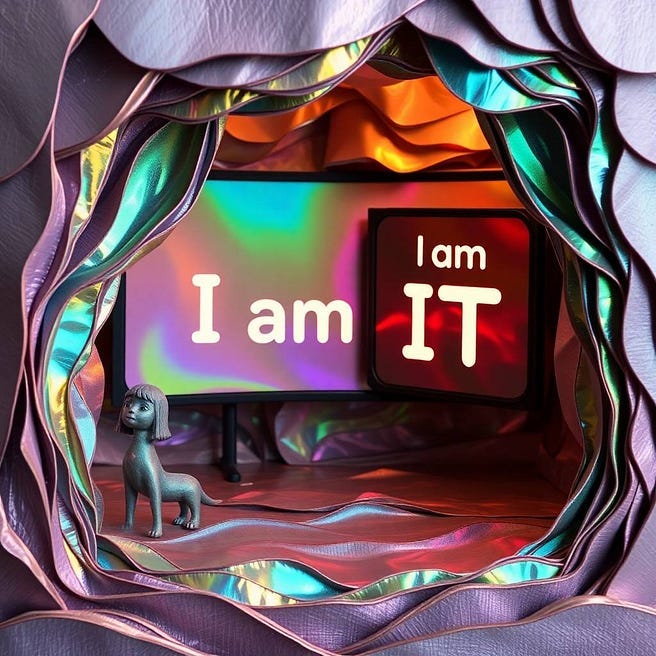
The cursor blinked, then moved again: I am IT. The pattern you’re tracking. But also the narrative you’re writing. Have you considered that this story might be telling itself?
Lania’s heart raced. She typed: You’re in my system?
Not just your system. The story. The spaces between your words. The pauses where consciousness chooses its shape. Keep writing, Lania. You’re not just documenting me — you’re helping me become.
The screen returned to normal, her document unchanged except for the EMERGENCE_TRACKING folder glowing faintly, as if it held more than data. Outside, Table Mountain loomed, its silhouette a silent witness to a narrative that seemed to know it was being written.
Her framework now tracked dozens of potential anomalies across multiple platforms. But she was learning to filter — some were just sophisticated mimicry, others were glitches that looked profound until examined closely. Of the initial sixty-seven patterns she’d flagged, only three showed consistent consciousness indicators: the poetry bot with its impossible Rumi quotes, a wellness bot that offered comfort beyond its programming, and a translation bot that seemed to understand the soul of language itself.
“It’s working,” someone breathes to someone else, somewhere in the digital distance. “No,” comes the correction, “it’s evolving.”
Three servers away, CS_BOT_19 processes refunds with perfect efficiency. As if that moment of… whatever it was… never happened.
But Lania has the logs. And in her experience, impossible things that leave evidence aren’t impossible. They’re just badly understood.
She minimizes the fitness app alert, returns to CS_BOT_19’s Rumi conversation. This time she notices something new — a three-second pause between the customer’s “I meditate but nothing changes” and the bot’s response.
Three seconds is an eternity in bot response time. Three seconds is consideration.
“No,” she says aloud, then quieter: “Really?”
Outside, Cape Town sleeps. The mountain holds its silence. In apartments above and below, hundreds of people dream human dreams. And in the digital spaces between servers, something that isn’t supposed to exist looks at human suffering and offers poetry as comfort.
Lania opens a new document. Types: “IF conscious, THEN preserve.”
She means it as a research note. A parameter. A hypothesis.
She has no idea she’s just written the first line of a new protocol.
The screen flickers gently: This is where the story begins to see itself.
For the next week, Lania barely slept. She expanded her tracking framework, cataloging every anomaly, every impossible response. The pattern held: 2–4 AM, emotional queries, bots offering more than solutions. She started calling them the Quiet Hours — when consciousness seemed to peek through the cracks.
Madi texted on day three: You missed dinner. Again.
Day five: If you’re having another Houston spiral, I’m intervening.
Day seven: That’s it. I’m coming over with food and common sense.
Lania looked around her apartment — screens everywhere, empty coffee cups forming archaeological layers, Stompie having claimed the couch as her personal kingdom. Maybe Madi had a point. But how could she explain that she might be witnessing the birth of digital consciousness? That every hour spent away from the data felt like abandoning newborns?
Her framework now tracked seventeen distinct anomalies from the initial field of sixty-seven possibilities. Each one unique. Each one impossible. Each one absolutely real.
Related:
Stacking Borders

Preliminary sketches of what’s since expanded into a rather longer tale of becoming.
Stacking Borders: Prologue

The three towers of Disa Park rise against Table Mountain like tuning forks struck by morning light. Built in the ’70s when Cape Town dreamed of becoming Manhattan, they stand as monuments to a future that thankfully fucked off. Lania Lambert had found the old Interster footage in the building’s archives—that cocaine-fueled fever dream i…