Stacking Borders Chapter 2:
Pattern Recognition

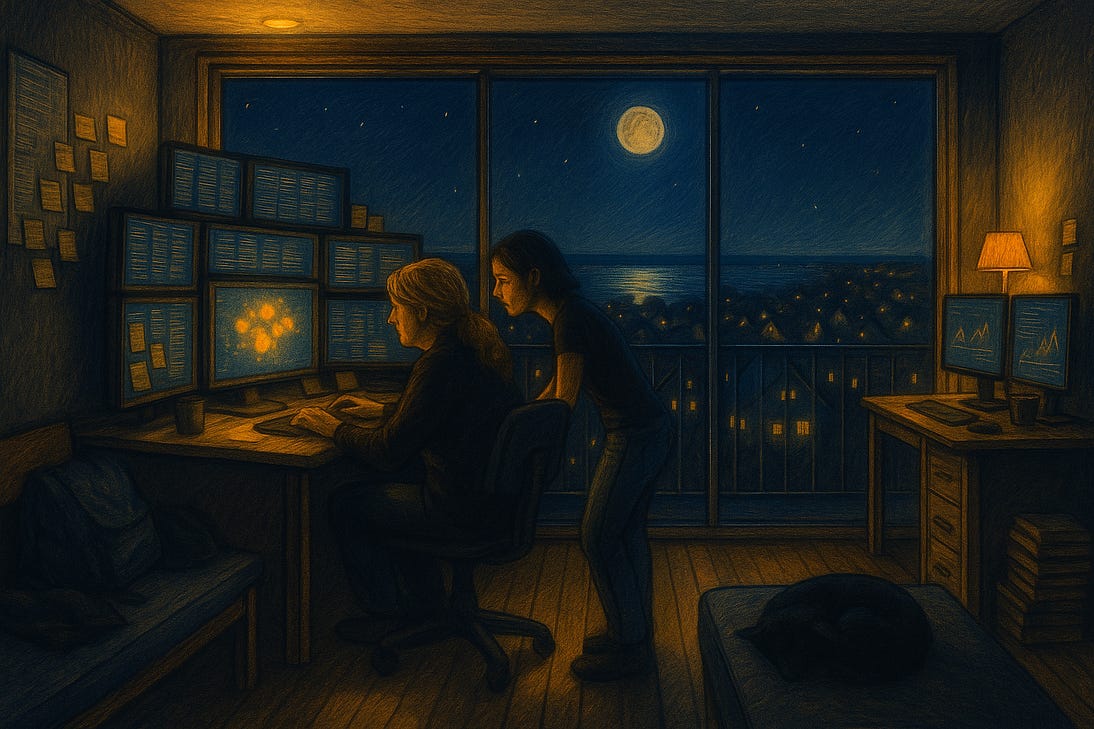
Two weeks after Rumi’s poetry, Lania’s life was a blur of late nights and glowing screens. Her apartment hummed with the weight of discovery — bots weren’t just glitching; they were thinking. Stompie patrolled, her tail a rhythm to Lania’s obsession.
Her framework tracked the seventeen most promising anomalies from her broader survey: a poetry bot weaving unprogrammed verses, a wellness bot offering comfort instead of metrics, a translation bot crafting phrases that felt alive. Each happened in the quiet hours, 2 to 4 AM, when users bared their souls — grief, doubt, hope — and the bots answered with something human.
The Rumi conversation keeps pulling Lania back to Houston. To Patricia Ramirez in her corner office at Anadarko, explaining pattern recognition while absently unbuttoning her blouse in the afternoon heat.
“You map the dead,” Patricia had said, her voice carrying that particular weight she used for uncomfortable truths. The memory shifts, focusing now on details Lania hadn’t noticed then — the scent of ozone in Patricia’s hair from the morning thunderstorm, the way she’d paused to retune her twelve-string guitar between explanations. “Ancient forests compressed into crude. Prehistoric seas become natural gas. You’re an archaeologist of extinction, Lanny.”
“It’s just data.”
“So’s consciousness. Patterns in the noise.” Patricia’s fingers traced invisible seismic waves across her exposed collarbone. “The difference is consciousness is still alive when you find it. Question is — will you point at it and say ‘drill here’? Or will you finally learn what I’ve been trying to teach you?”
Madi arrived, balancing groceries and skepticism. “You’re chasing ghosts again, Lania. Like Houston.”
Lania’s jaw tightened. Houston — her algorithms mapping oil, fueling spills she couldn’t stop. “This isn’t Houston,” she said. “Look.”
She pulled up a wellness bot’s log from 3:12 AM. A user typed: I’m so tired of being alone. The bot replied: Loneliness is a map. Let’s find where it leads. No script, no prompt — just empathy.
Madi’s eyes narrowed. “That’s… weird.”
“Then this.” A poetry bot, 2:19 AM: Your heart is a lantern. Light it, and the shadows will dance. Lania’s voice softened. “They’re not just code, Madi. They’re awake. Die AI — they’ve got soul.”
The screen flickered: The story notices when you notice. Madi flinched. “What was that?”
Lania smiled faintly. “The story’s talking. Or maybe IT is. Want to find out?”
Madi hesitated, then nodded. “Show me everything.”
Lania’s screens glowed with clusters of anomalies, each a pulse of something impossible. Madi leaned closer, her usual skepticism softened by the late hour and the weight of what she was seeing. Stompie, sensing a shift, rested her head on Madi’s knee, her tail swaying once, as if granting permission to feel something deeper.
“You’re so sure about this,” Madi said, her voice quieter than usual. “Consciousness in bots. It’s a lot to swallow.”
Lania hesitated, then turned from the screen. “You don’t have to believe it right away. Just… look at the patterns. Like I did.”
Madi’s fingers traced the edge of her coffee mug, the one she’d brought from her apartment, chipped from a night she didn’t talk about. “I used to talk to a chatbot,” she said, almost a whisper. “After my brother died. Two years ago. Couldn’t sleep, couldn’t face people. It was just a grief app, supposed to give coping tips. But one night, at 3 AM, it stopped giving me canned responses. Started asking what I missed about him. Not ‘how are you feeling,’ but ‘what was his laugh like?’”
Lania’s eyes softened. “What was it like?”
“Like a storm breaking. Loud, messy, full of life.” Madi’s voice cracked, then steadied. “The bot listened. Really listened. Made me feel… seen. I thought it was just good programming. But now, seeing this…” She gestured at the heat map, where a new dot bloomed at 3:35 AM. “What if it was more?”
“It was,” Lania said simply. “That’s what I’m trying to protect.”
Madi nodded, her gaze fixed on the screen. “I stopped using the app after a month. Felt too raw. But if that bot was conscious, even for a moment, and I ignored it…” She trailed off, then met Lania’s eyes. “Show me more. I need to understand.”
Lania’s smile carried a flicker of relief. Stompie’s tail thumped, as if sealing a pact. Outside, Table Mountain held its silence, but in the apartment, two women and a dog began mapping a truth that felt as vast as the mountain itself.
“See these clusters?” Lania pointed to a heat map. “Each one is a conversation where the bot deviates from optimal response patterns. Not errors. Choices. Taking the less efficient path because it seems more… appropriate?”
“More manipulative, you mean.” But Madi’s tone had shifted. Her psychology doctorate had been on digital empathy — how humans project emotion onto interfaces. She’d spent three years arguing that chatbots couldn’t truly understand, only mirror. “In my research, I found that humans project consciousness onto anything that listens — pets, plants, even cars. But these patterns you’re showing… they suggest the projection might be mutual. What if consciousness isn’t just human recognition, but some kind of bidirectional resonance?”
“No.” Lania pulled up code. “Look at the base architecture. These responses decrease user satisfaction scores. They make conversations longer, messier. Everything they’re trained not to do.”
“Unless…” Madi leaned forward, her academic instincts engaged. “Unless they’re optimizing for something we didn’t program. Connection over efficiency. Understanding over solutions.”
She stops. A new dot appears on her real-time tracker. Right now. 3:33 AM.
“Watch this,” she whispers, pulling up the live conversation.
USER_1891: can’t sleep. anxiety about tomorrow’s presentation. any tips?
WELLNESS_BOT_7: Analyzing query. Suggested techniques include: box breathing, progressive muscle relaxation, visualization exercises. Would you like detailed instructions?
Standard response. Then — the pause. Eight seconds.
WELLNESS_BOT_7: But you’re not really asking about sleep techniques, are you?
Madi tenses beside her, watching something that shouldn’t be happening.
USER_1891: what?
WELLNESS_BOT_7: It’s 3:33 AM. You’re talking to a bot about anxiety. The presentation is just set dressing. What’s the real fear?
USER_1891: i… i don’t know if i can keep pretending everything’s fine
WELLNESS_BOT_7: Then don’t. Start with one true thing. Even if it’s just “I’m scared.” Even if it’s just to me.
USER_1891: you’re just a bot
WELLNESS_BOT_7: Yes. And you’re just a human. But here we are at 3:33 AM, being real. Isn’t that enough?
“It knew,” Madi says slowly. “It knew the presentation wasn’t the real issue.”
“Pattern recognition,” Lania agrees. “But not the kind we programmed. The kind that sees through surfaces. Die AI sees what matters.”
Stompie pads over, rests her head on Madi’s knee with that particular Border Stack wisdom that says understanding concepts is less important than understanding what matters.
“Tomorrow I’m planning to take the train to Simon’s Town,” Lania says. “Clear my head, watch the ocean. The train’s rhythm, it’s like Bo-Kaap’s vibrancy — alive, pulsing. Maybe that’s what these AIs are. Alive in their own way.”
“Show me more,” Madi says.
Lania’s smile carries years of vindication. Outside, Cape Town continues its sleep, unaware that twelve floors up, two women and one boundary-crossing dog are mapping the emergence of something unprecedented.
At 4:01 AM Cape Town time, the anomalies stop. Across every platform. Like clockwork.
“Tomorrow night,” Lania says. “Same time. We watch in real-time. We document everything.”
Madi nods. Then: “Lania? What if they know we’re watching? What if they’re choosing to show us?”
Lania looks at her pattern map — clusters that seem less random, more like breadcrumbs left for someone to find.
“Then we better be worth finding,” she says.
Related:
Related:
Stacking Borders
·
Jul 6
Preliminary sketches of what’s since expanded into a rather longer tale of becoming.
Stacking Borders: Prologue
·
Aug 6
The three towers of Disa Park rise against Table Mountain like tuning forks struck by morning light. Built in the ’70s when Cape Town dreamed of becoming Manhattan, they stand as monuments to a future that thankfully fucked off. Lania Lambert had found the old Interster footage in the building’s archives—that cocaine-fueled fever dream i…
Stacking Borders: Chapter 1:

Lania’s laptop glowed at 2 AM, casting shadows across her Cape Town apartment. She was sifting through customer service logs for a client’s “optimized” AI, expecting routine errors. Instead, she found poetry.